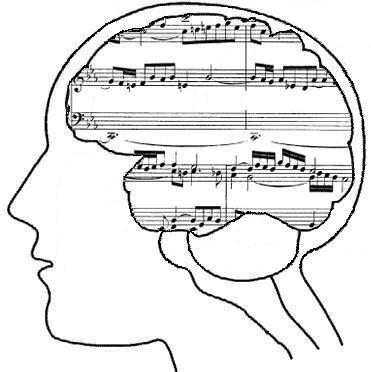
Music has a remarkable ability to affect and manipulate how we feel. Simply listening to songs we like
stimulates the brain’s reward system, creating feelings of pleasure and comfort. But music goes beyond our hearts to our minds, shaping how we think. Scientific evidence suggests that even a little music training when we’re young can shape how brains develop, improving the ability to differentiate sounds and speech.
With education funding constantly on the rocks and tough economic times tightening many parents’ budgets, students often end up with only a few years of music education. Studies to date have focused on neurological benefits of sustained music training, and found many upsides. For example, researchers have found that
musicians are better able to process foreign languages because of their ability to hear differences in pitch, and
have incredible abilities to detect speech in noise. But what about the kids who only get sparse musical tutelage? Does picking up an instrument for a few years have any benefits?
The answer from a study just published in the Journal of Neuroscience is a resounding yes. The team of researchers from
Northwestern University’s Auditory Neuroscience Laboratory tested the responses of forty-five adults to different complex sounds ranging in pitch. The adults were grouped based on how much music training they had as children, either having no experience, one to five years of training, or six to eleven years of music instruction.
Music training had a profound impact on the way the study subjects’ brains responded to sounds. The people who had studied music, even if only for a few years, had more robust neural processing of the different test sounds. Most importantly, though, the adults with music training were more effective at pulling out the fundamental frequency, or lowest frequency sound, of the test noises.
“The way you hear sound today is dictated by the experiences with sound you’ve had up until today,” explained co-author and lab head Nina Kraus. As she and her colleague wrote
in an article for Nature, “akin to physical exercise and its impact on body fitness, music is a resource that tones the brain for auditory fitness.”
Bulking up the auditory brain has non-musical implications.
The ability to differentiate fundamental frequencies is critical for perceiving speech, and is an integral part of
how we recognize and process sounds in complex and noisy environments. Thus childhood music instruction has strong linguistic benefits and improves performance on everyday listening tasks. Since we live in an inherently noisy world, the better we are at focusing on sound and perceiving different sounds, the better. This can be particularly important for children with learning disorders or those for whom English is a second language.
There is a body of research that suggests music training not only improves hearing, it bolsters a suite of brain functions. Musically trained kids do better in school, with
stronger reading skills,
increased math abilities, and
higher general intelligence scores. Music even seems to improve social development, as people believe music helps them be
better team players and
have higher self-esteem. “Based on what we already know about the ways that music helps shape the brain, the study suggests that short-term music lessons may enhance lifelong listening and learning,” said Kraus. “Our research captures a much larger section of the population with implications for educational policy makers and the development of auditory training programs that can generate long-lasting positive outcomes.”
The importance of music education is something to consider, given that election season is in full swing. According to
a recent White House report, more than 300,000 education jobs have been lost since the “end” of the recession in 2009 – 7,000 were lost last month alone. As schools lose funding, arts and extracurricular programs are often first on the chopping block, meaning less music education for the nation’s youth. Given the scientific evidence supporting the importance of music both neurologically and educationally, the loss of music education seems particularly painful. Perhaps as we head to the polls this season, we should give even more thought as to how our choices of elected officials might affect the education system in this country and the brains of the children who are its future.
Citation: Skoe, E. & Kraus, N. (2012). A Little Goes a Long Way: How the Adult Brain Is Shaped by Musical Training in Childhood, Journal of Neuroscience, 32 (34) 11510. DOI:
10.1523/JNEUROSCI.1949-12.2012
Music brain image from
the Department of Homeland Security
 Once, a group of 50 people was attending a seminar. Suddenly
the speaker stopped and started giving each person a balloon. Each one was asked
to write his/her name on it using a marker pen. Then all the balloons were collected
and put in another room.
Once, a group of 50 people was attending a seminar. Suddenly
the speaker stopped and started giving each person a balloon. Each one was asked
to write his/her name on it using a marker pen. Then all the balloons were collected
and put in another room.